


What do you do when the life you worked so hard to build… stops fitting?
Not because you failed.
Because you succeeded.
I did everything right.
Stable marriage. Responsible choices. Children raised. Community served. I became the woman people describe with admiration: dependable, steady, selfless.
From the outside, my life looked solid.
Inside, something was quietly shrinking.
There was no dramatic unhappiness. No scandal. No implosion.
Just a growing awareness that I was living a life that worked — but wasn’t entirely mine.
I had become exceptionally skilled at being needed.
If you had asked me who I was, I would have listed my roles. Wife. Mother. Organizer. The one who handles it. The one who smooths it over. The one who absorbs the impact.
I was proud of that woman.
But I didn’t realize how much of her identity depended on being indispensable.
Then the scaffolding disappeared.
My children left for college.
My husband retired.
We moved.
And eventually, my marriage ended.
The structure that had organized my days — and justified my usefulness — dissolved.
I wasn’t just losing a relationship.
I was losing the identity that relationship required.
And beneath the grief was something more destabilizing:
If I am no longer essential to everyone else… who am I?
And more quietly:
If I am not needed… am I still loved?
For years, usefulness had been my currency of belonging.
I was valued for how much I could carry.
For how little I required.
For how smoothly I kept everything running.
And that strategy worked.
It built a good life.
It also cost me something I didn’t know I was trading away.
When the structure fell, I began to see how automatic I had become.
I said yes before I checked in with myself.
I avoided conflict even when it meant betraying my own opinion.
I prioritized harmony over honesty.
I minimized my desires before anyone could dismiss them.
Not because I was weak.
Because I had trained my nervous system to equate safety with agreeability.
One afternoon a friend asked me to take on something I didn’t have the bandwidth for. I heard myself begin to say yes — reflexively.
And then I paused.
My chest tightened. My throat felt dry.
“I can’t,” I said.
She looked surprised. Slightly disappointed.
Nothing catastrophic happened.
But something seismic shifted inside me.
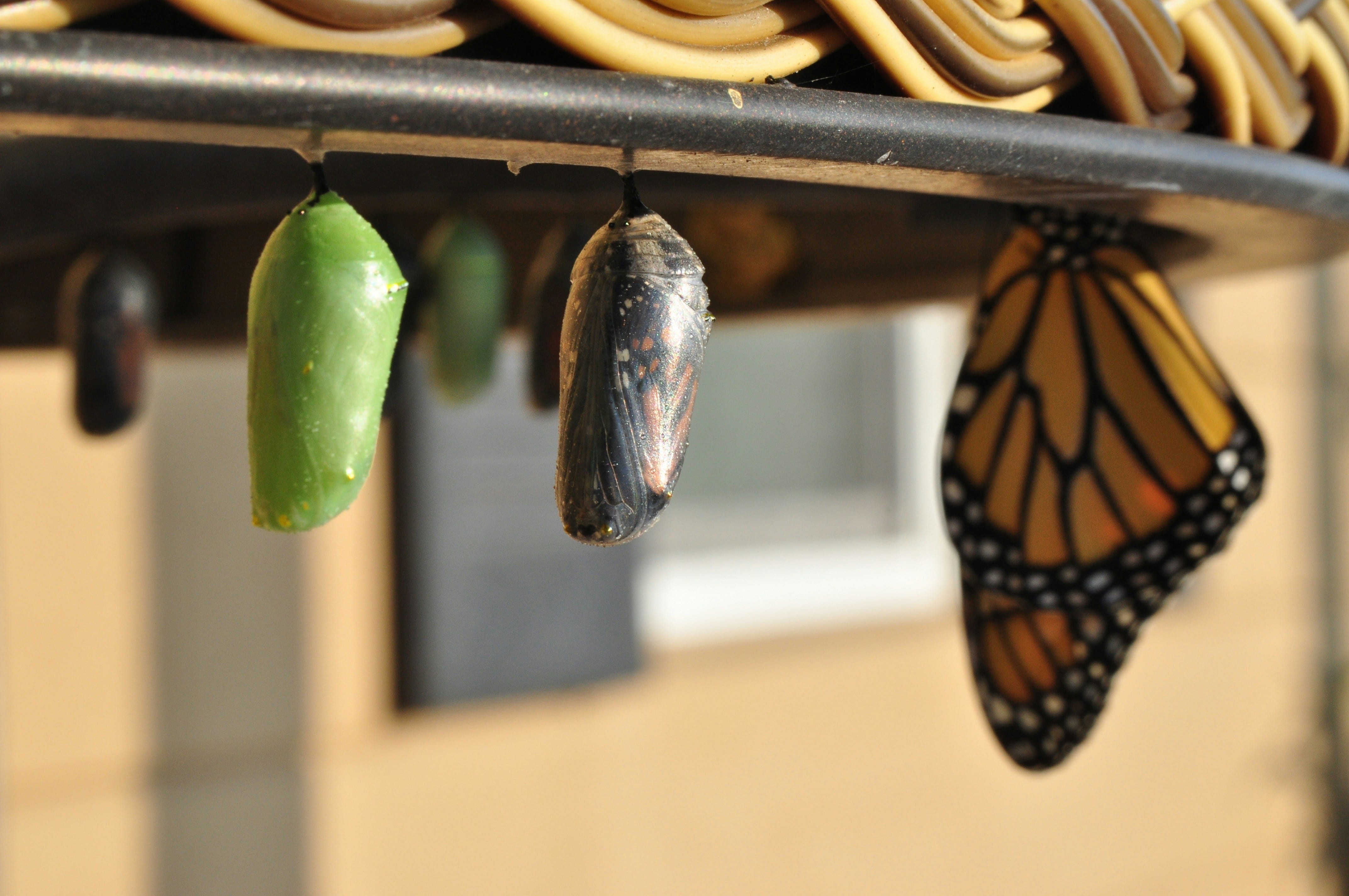
For the first time, I chose truth over approval.
That was the beginning.
I realized nothing was wrong with my life.
It had simply stopped fitting the woman I was becoming.
Part of me wanted to rebuild the familiar structure — to become indispensable again. To slip back into the comfort of being the strong one, the stable one, the needed one.
But I could feel the cost now.
Staying the same would mean abandoning myself in quieter, more sophisticated ways.
And here is the part we don’t talk about:
When you stop being endlessly reliable, some people get uncomfortable.
When you stop anticipating everyone else’s needs, they notice.
When you no longer define yourself by usefulness, you disrupt the ecosystem.
Growth is not neutral.
It rearranges relationships.
I began asking a different question.
Not “What should I do?”
Not “What will keep things smooth?”
But: “What is true for me — even if it disappoints someone?”
Some choices were small.
Some were uncomfortable.
Some changed dynamics permanently.
I grieved the woman I had been. She wasn’t wrong. She was doing her best with the blueprint she inherited.
But she was not the final version of me.
I started meeting other women in similar transitions — after divorce, after children left home, after careers ended, after health scares. Women who had done everything right and were privately wondering why they felt invisible inside their own success.
This isn’t failure.
It’s not ingratitude.
It’s not instability.
It’s what happens when you try to enter a new chapter with an identity built for the previous one.
Outgrowing your life is not a crisis.
It’s a reckoning.
It asks:
Are you willing to be less needed in order to be more alive?
Are you willing to disappoint others so you stop disappointing yourself?
Are you willing to let go of the praise attached to who you were?
Not everyone will celebrate your evolution.
Some roles will fall away.
The old version of you will always be tempting — she is efficient, admired, safe.
But there comes a point when maintaining who you’ve been requires more self-abandonment than becoming who you are.
That’s the threshold.
And crossing it changes everything.
If you can stand behind that publicly, this piece becomes not just reflective — but catalytic.
Another article you may enjoy:

Tarot Pull
Seven of Wands Reversed
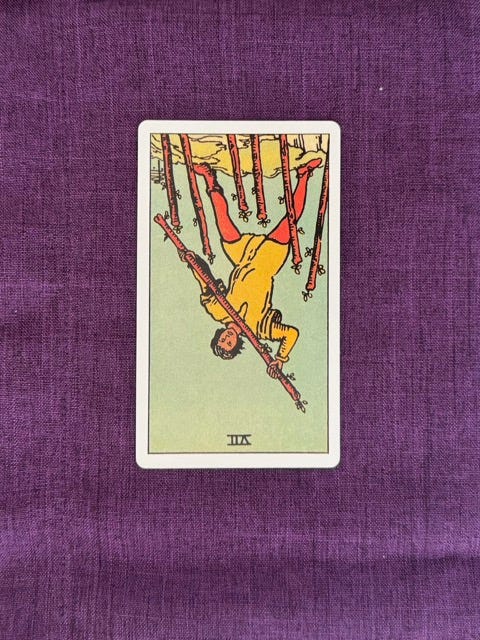
Upright, Seven of Wands is:
Defensiveness. Holding your ground. Protecting your position. Fighting off challengers. “I have to prove I belong here.”
Reversed the energy shifts.
It asks:
Why are you still fighting?
What are you defending?
Who told you this was a battlefield?
You built an identity about being useful and now that is shifting, but your nervous system hasn’t gotten the message yet.
Time to reevaluate.