


Why should I be labeled by what I’m NOT???
My parents divorced when my mom was 45. My dad remarried — twice — and eventually died at 79. After that, my mom began referring to herself as a widow, even though she’d been divorced far longer than she’d been married.
Mom always hated being labeled “divorced.” Why should she be defined by what she wasn’t — by a failed relationship? Couldn’t she simply call herself single? Technically, she was. But for some reason, society doesn’t roll us back to single. Once divorced, always divorced. In France, after you get divorced, you get your original last name back. (Which only brings up the question of why women change their names anyway — to become some kind of possession of their husband...? I’m not for it... obviously!!!)
Back to where I was: when my dad died, Mom was oddly relieved. Finally, she could call herself a widow — a label with dignity, sympathy, and even respect.
It made me think about how language shapes our sense of self. Divorced implies failure, rejection, or loss. Yet the word itself is neutral. It comes from Latin:
dis- = apart or away
vertere = to turn
So, it literally means to turn away from one another.
No judgment. No shame. Just two people taking separate paths.
So maybe we need new language for these big, brave transitions. Words that celebrate what’s next instead of what’s over.
But in my mother’s Catholic world, divorce was a moral failing. The Church didn’t recognize a civil divorce. “Let no man break what God has joined…” Her priest even offered her an annulment since my father wasn’t a practicing Catholic. But my mother refused. How could she erase a marriage that had produced four children? Would that mean we were born out of wedlock? Since there was technically not marriage if it was annulled? Why would the church make such an offer?
I admired my mom’s integrity. Still, she lived the rest of her life alone — not dating again until after my father’s death, when she could finally, safely call herself a widow.
I lost much of my respect for the Church over this. It’s not God who is rigid; it’s the men who made the rules — celibate men in robes dictating the emotional realities for families.
But the whole “being labeled by what you aren’t” isn’t just about religion.
Retirement carries the same energy.
When you’re retired, you’re defined by what you’re no longer doing. You’re not working. You’re not producing. You’re not contributing to “the system.” The word suggests withdrawal, when in truth, for many people, it’s the beginning of a creative renaissance — a chance to live, explore, and grow on your own terms.
So maybe we need new language for these big, brave transitions. Words that celebrate what’s next instead of what’s over.
Because the truth is, we’re not divorced or retired.
We’re ready to step into our freedom and live our best life.
What word would you choose to describe your next chapter — one that defines you by your freedom, not your past?
Tarot Pull
The Ten of Pentacles
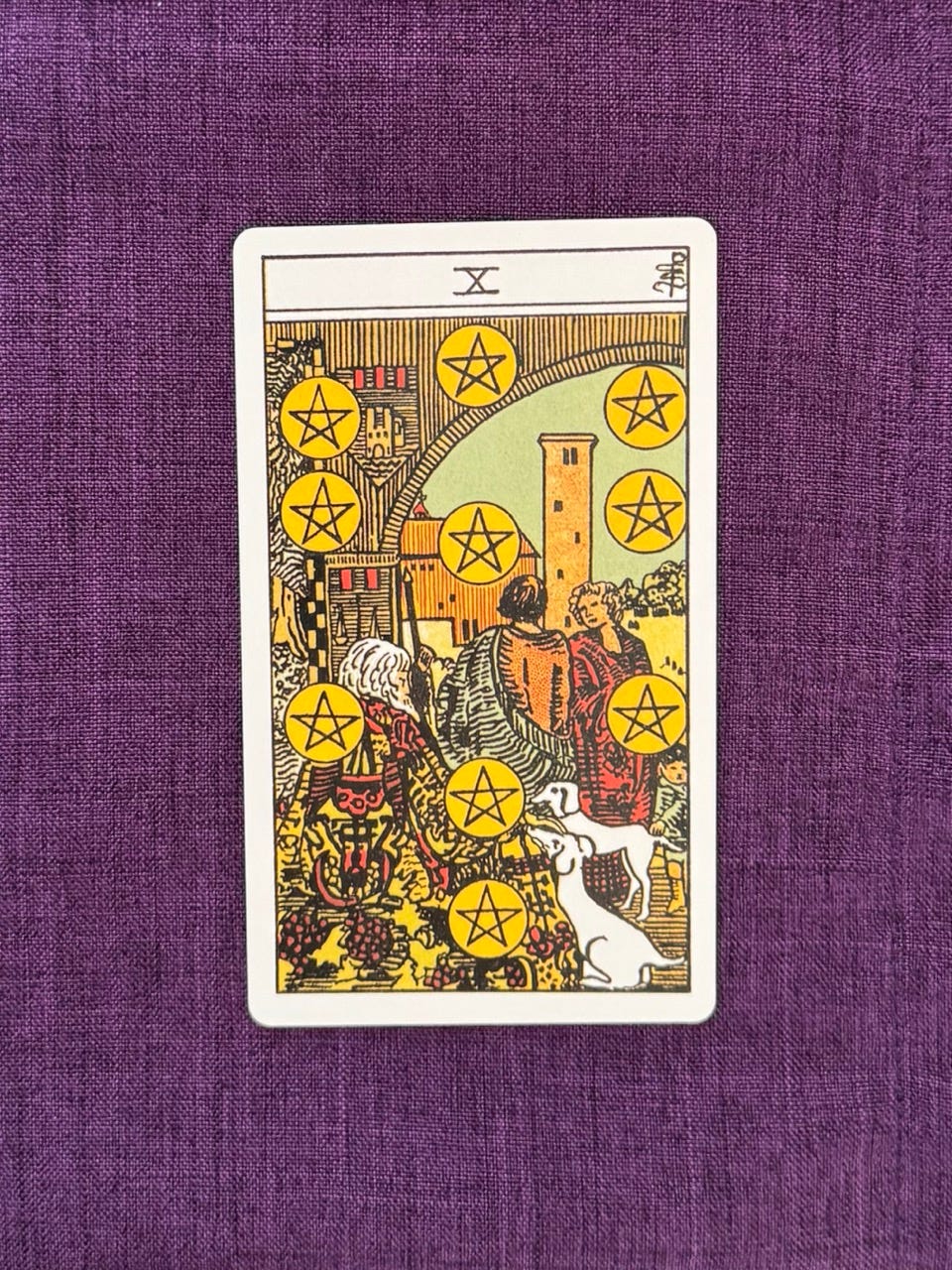
When I pulled the Ten of Pentacles for this piece, it made sense. This card is about legacy — the stories we inherit and the ones we choose to pass on. My mother’s generation was defined by the labels they were given. Ours gets to rewrite them. Maybe our legacy won’t be measured by who we married or what we did for work, but by how courageously we became ourselves.