



Last week a friend played a gotcha joke on me.
For a few seconds, I genuinely believed something terrible had happened.
Then came the reveal.
I laughed politely.
But inside, something much older had already been activated.
At first I thought I was simply hurt by the joke.
Then came something even more painful.
Shame.
I felt foolish for believing it. I felt too sensitive for not finding it funny. I felt embarrassed that I had reacted so strongly.
Without thinking, I did what I have done for decades.
I withdrew.
Not because my friend rejected me.
Because I rejected myself.
That was the real revelation.
The Voice That Hurt Me Most Was Mine
For years, I thought self-abandonment happened in big moments.
Staying too long in the wrong relationship. Never asking for the promotion. Ignoring my dreams.
Now I think it often happens in less than five seconds.
An incident occurs. A feeling arises. And then...
I judge myself for having the feeling.
That’s the moment everything changes.
I finally had a name for the pattern that had followed me through much of my life.
Trigger → Feeling → Self-Judgment → Shame → Withdrawal
The trigger wasn’t the problem. The feeling wasn’t the problem. The problem was the judgment.
Nothing changed for me until I realized the judgment wasn’t coming from my friend.
It was coming from me.
“How could you be so stupid?” “Why would you fall for that?” “What’s wrong with you?”
Before my friend had even finished laughing, another voice had entered the room.
Mine.
That voice took me straight back to old stories.
You’re not smart enough. You’re too sensitive. You’re not enough.
No wonder I withdrew.
The Pattern Interrupt
As I sat with the experience, I realized I needed what I often forget I know.
A pattern interrupt.
Not changing the trigger. Changing what happens after it.
What would agency look like here?
I began imagining a different pathway.
Trigger → Feeling → Curiosity → Self-Compassion → Choice
Notice what changed.
Not the event. Not the feeling. Only what happened next.
Curiosity interrupted certainty.
Judgment says: “I know what this means.” Curiosity says: “I wonder what this means.”
The difference between those two sentences is the difference between abandoning yourself and staying.
Curiosity Lives in the Space
Viktor Frankl famously wrote:
“Between stimulus and response there is a space. In that space is our power to choose our response.”
For years I thought that space was filled with willpower.
Now I think it is filled with curiosity.
Curiosity gives our nervous system another option besides old programming.
Instead of immediately deciding what something means — we become interested. Instead of condemning ourselves — we become compassionate. Instead of abandoning ourselves — we stay.
A Different Response
If I could replay that moment today, perhaps it would sound something like this:
“Wow. That really got me. I genuinely thought something awful had happened. No wonder my body reacted the way it did.”
“Interesting... I notice I don’t actually enjoy this kind of teasing. My friend and I probably just have different senses of humor.”
“I don’t know whether my friend intended to hurt me or not.”
“What I do know is what happened inside me.”
“So... what do I want to do now?”
That question changes everything.
Not: Who’s right?
But: What do I need?
That is agency.
Choosing Yourself
Agency isn’t about controlling life.
People will still disappoint us. We will still be misunderstood. We will still get triggered.
Agency doesn’t eliminate those experiences.
It changes what happens after them.
Instead of immediately turning against ourselves, we learn to remain on our own side.
Feel the feeling. Stay curious. Offer yourself compassion before criticism. Then choose.
Again and again and again.
Perhaps that’s how self-trust is built.
Not through one dramatic breakthrough.
But through hundreds of moments when we refuse to abandon ourselves.
Because I’m beginning to believe that choosing yourself isn’t one grand decision.
It’s what happens in the quiet space between the trigger...
and the shame.

The Tarot Nook
The Page of Swords
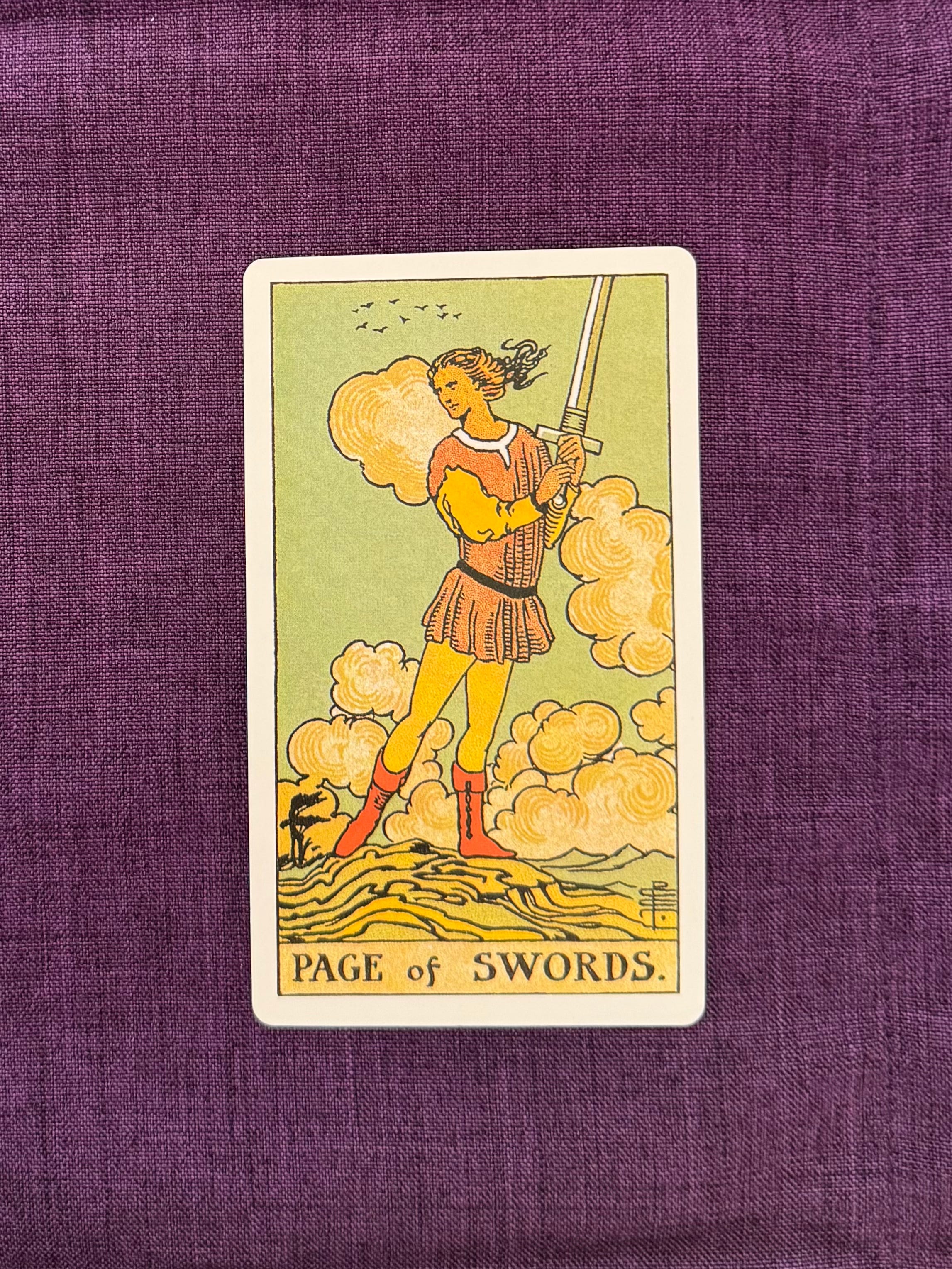
This is the perfect card for this blog. The Page of Swords is all about curiosity! He is the learner who wants to understand what is going on. He even questions the stories we tell ourselves… He challenges the inner critic to ask if the story is really true.
The entire pattern interrupt is an invitation to become an investigator of our own inner dialogue.
Instead of accepting the first interpretation our inner critic offers, you pause and ask:
“Is that actually true?”
That simple question is pure Page of Swords—and it’s also one of the clearest expressions of agency.
Crazy to pull the Page of Swords on this one! A great read ‘Lici
This is so important!