


Walking down the aisle of a Weis Market in Havre de Grace, Maryland, I was following a young man who had offered to show me where to find bottled water when I heard a voice behind me.
“Ma’am… Ma’am…”
I turned around. A slightly out-of-breath woman in her twenties was weaving toward me through the carts. She stopped, caught her breath, and said, “I just had to tell you—you look so beautiful. I love your whole outfit. Have a great day.”
And off she went.
At 67, people are not usually chasing me down to tell me I look beautiful. I mumbled thank you. The man said, “The water is this way.” And I floated through the rest of the store—standing taller, chin up, something lit from the inside.
I told my sister about it later.
“Well,” she said, “you look great.”
There is something about unsolicited acknowledgment that nothing else quite replicates.
Her compliment did not create my beauty. But it exposed my hunger to have someone notice it.
I wish I could say I had completely outgrown that hunger.
I haven’t.
Why Women Feel Invisible After 55
When you are younger, the world constantly reflects you back to yourself.
Men notice you. Employers invest in your potential. Children need you. Society markets to you. People seek your attention, your labor, your care.
The world keeps sending back evidence that you have a place in it.
As you age, those reflections begin to diminish. And you start to feel invisible.
But perhaps what has actually happened is that you have lost the mirrors you were using to know your worth.
Those mirrors were always conditional. They reflected you when you were performing a socially valued function.
And here is the more uncomfortable truth:
Perhaps women do not become invisible after 55. Perhaps the culture simply stops rewarding the forms of womanhood it knows how to recognize. It has never learned to see the woman who has finally stopped performing for it.
The world has plenty of mirrors for the maiden and the mother.
It offers very few for the woman who belongs primarily to herself.
We call this invisibility. But often what we are really grieving is the loss of witnesses.
And there is a difference.
Social Menopause
Menopause changes how your body works.
Social menopause changes the terms under which the world agrees to notice you.
The attention once offered for beauty, fertility, service, and usefulness begins to recede—whether you wanted that attention or not.
As you age, the identity you have carried starts to shift beneath you. The roles that once made you legible to others—attractive, fertile, caregiving, productive—begin to loosen.
And in the space they leave behind, a disorienting question surfaces:
Who am I now?
Who do I even want to be?
I sit between stories.
The first story was:
Be beautiful.
Be chosen.
Be useful.
Raise children.
Support everyone.
Keep the family intact.
Make something of yourself.
I am no longer living that story.
But the next one has not fully announced itself yet.
For a while, I thought the spotlight had simply moved to my children and I had been reduced to a supporting role.
But their lives are not the sequel to mine.
They are separate stories entirely.
I am still the central character in my own.
My second story, I am beginning to understand, is this:
I no longer organize my identity around who needs me. I organize it around what feels alive in me.
The Hunger to Be Witnessed
What I craved most in my marriage was not praise.
It was something quieter and more essential than that.
I wanted my husband to witness me.
I wanted him to say:
I see the effort you made.
I see what this has cost you.
I see who you are becoming.
I see what you carried when nobody thanked you.
I wanted him to be proud to stand beside me.
Not constant applause—just acknowledgment that I existed and was evolving.
When that recognition did not come, I began to mistake his failure to see me for evidence that there was nothing worth seeing.
Slowly, quietly, I lost my sense of self.
Being looked at is not the same thing as being valued.
Being desired is not the same thing as being loved.
Being busy is not the same thing as being needed.
And yet I had spent years confusing each of those pairs—performing for mirrors that were never really showing me myself.
Some of the Invisibility Is Real
Of course, not all of this is happening inside us.
Some of the invisibility is real.
Older women are talked over, overlooked, underestimated, dismissed, and treated as though their most meaningful years are behind them. Their experience is often ignored. Their bodies disappear from advertising. Their opinions are treated as less relevant. Their ambition is regarded as surprising.
We should not spiritualize away a culture that genuinely looks past aging women.
But the culture’s blindness becomes even more dangerous when we begin using it as our own mirror.
When the world stops reflecting our value, do we stop believing it exists?
That is the deeper danger.
What I Had Been Outsourcing
As I have examined the different ways I abandoned myself, a pattern has emerged.
The resentment I felt came from outsourcing my boundaries.
The indecision I lived in came from outsourcing my authority.
The exhaustion I carried came from outsourcing my identity to the roles I performed.
The invisibility I stood in came from outsourcing my worth.
If your worth has depended on being desired, needed, admired, useful, or indispensable, then invisibility feels terrifying.
Because it seems to confirm what you feared all along:
That without a role to play, you do not quite exist.
But perhaps the problem was never only that others stopped seeing you.
Perhaps it was also that you stopped seeing yourself.
Or, more precisely, the parts of you that matter most—your wisdom, your depth, your courage, your compassion, your resilience, your hard-won experience—were never being reflected back by those mirrors in the first place.
Those are not the qualities our culture is trained to reward in women.
Where did we learn that being noticed was the same thing as existing?
What Becomes Possible
Human beings need to be witnessed.
Wanting recognition does not mean you are spiritually underdeveloped. We are relational creatures, and there is no shame in wanting someone to see us.
The goal is not to become so self-contained that no one’s attention matters.
The more nuanced truth is this:
I can know my worth without pretending I never need anyone to see me.
Self-validation does not mean becoming immune to recognition.
Compliments still warm us. Love still nourishes us. Being witnessed still matters.
The difference is that another person’s gaze becomes a gift—not life support.
I am still grateful to that young woman in Weis Market. Her compliment delighted me. It reminded me that being seen can be a small act of grace.
But the greater gift was what happened afterward.
For a few minutes, I walked differently because she saw me.
The question I now carry is whether I can learn to walk that way before anyone says a word.
Not because I no longer need other people.
But because another person’s gaze can delight in my light.
It should not be responsible for creating it.
It can warm me.
It cannot be the source of my flame.
Can I remain visible to myself?
That is the question for this chapter.
Self-Abandonment
If you think you’ve abandoned yourself, take this simple assessment and see. It’s free! If you have noticed a friend who is experiencing something similar, share this post with them.
The Tarot Nook
Six of Pentacles Reversed
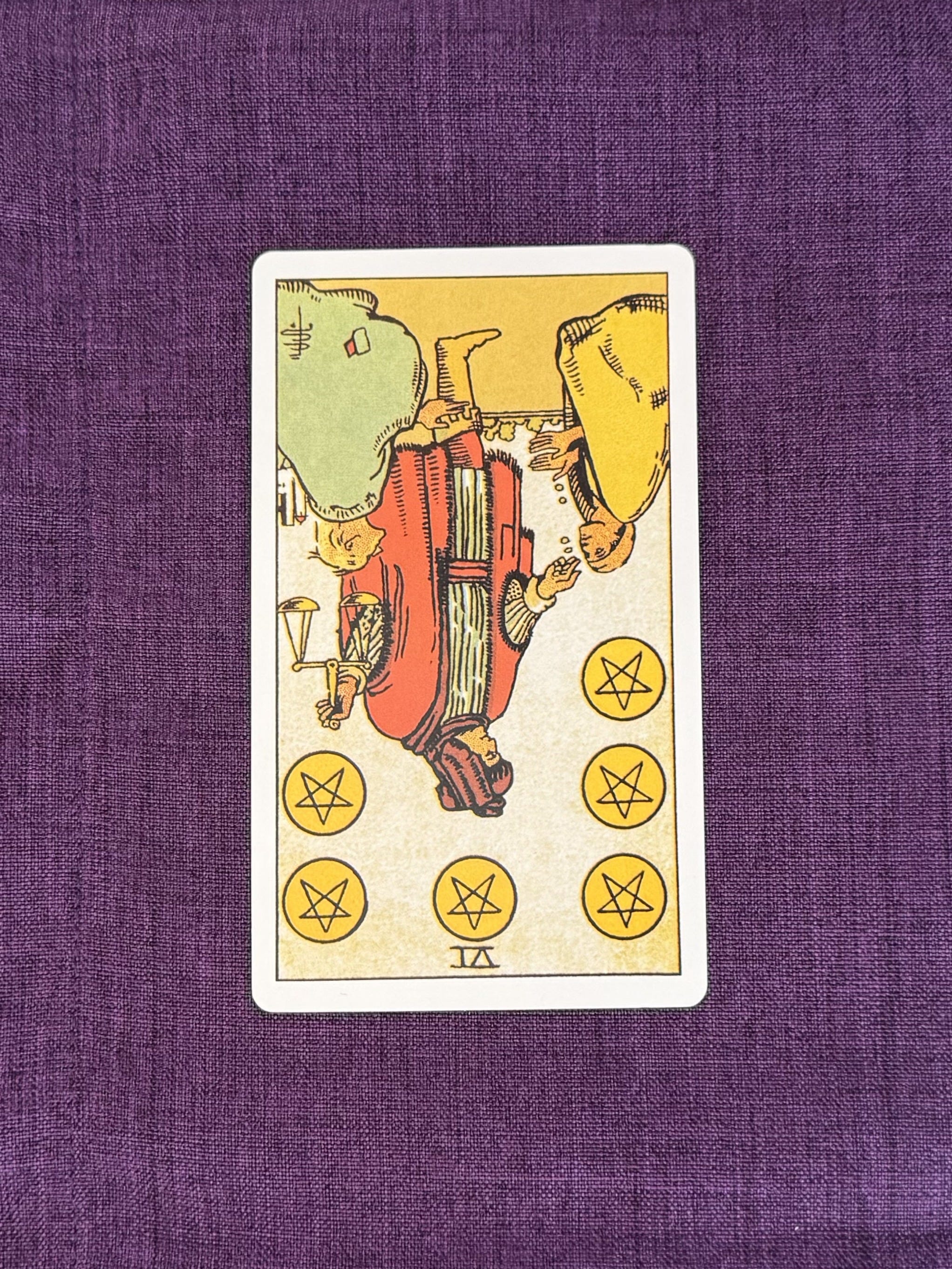
Upright, the Six of Pentacles is about generosity, giving and receiving, reciprocity. Reversed, it’s about power struggles and conditional reciprocity. This is exactly what the blog is talking about: me giving away my agency to my husband.
Worth that can be granted by another can also be withheld by another, giving them control.
Who have you given the authority to decide what you’re worth?
It’s like living under the belief that if I give enough, I will feel valued, that your worth is earned through performance.
This shines the light on the need to stop outsourcing our self-worth and let it shine from within. Know at your core your worth. Recognize your own value.