



At 35, I wanted a partner to build a life with.
At 67, I already have a life.
I have children. Friends. Work I care about. A dog. Places I want to go. Things I want to learn. A house I am making my own. A growing list of experiences I still want to have.
I am no longer looking for someone to create a life for me.
Which raises a much more interesting question:
What do I want a relationship to add to the life I already have?
After 30 years of marriage, I approach the idea of “relationship” from a very different place than I did as a 35-year-old whose biological clock was ticking so loudly I could practically hear it from another room.
Back then, I was thinking about marriage, family, children, building a future.
Now I am thinking about something else entirely:
How do two fully formed adults come together without either one disappearing?
I have been thinking about this a lot lately.
Five standards keep rising to the surface.
Standard Number One: If You See Something, Say Something
I stole this from a sign at the Chase Center. Go Valkyries.
But I think it applies beautifully to relationships.
If I make an effort, notice it.
If I get dressed up, say something.
“Wow. You look fabulous.”
If I clean the kitchen:
“Nice job. Thank you.”
If I seem off:
“Everything okay? Your smile seems to be missing today.”
If I’ve clearly spent the day running around:
“You’ve been busy. Come sit down.”
This isn’t really about compliments.
It’s about attention.
I want to be with someone who notices me.
And I want to notice him.
Those tiny acknowledgements say: I see you. I’m paying attention. What you do matters to me.
We talk so much about grand romantic gestures, but I suspect these tiny bids for connection are actually the cement holding a relationship together.
Being seen matters.
Perhaps more than we admit.
Standard Number Two: Just Do It
Thank you, Nike.
This one is closely related to being seen.
If you see something that needs doing, do it.
Take out the trash.
Set the table.
Start the laundry.
Vacuum.
Make the reservation.
Pick something up at the store.
Handle the thing before it becomes someone else’s job to ask you to handle the thing.
There is something deeply attractive about living with another competent adult who notices what needs to be done and acts.
It isn’t really about chores.
It’s about not having one person carry the mental load of the relationship.
I don’t want to manage a partner.
I don’t want to hand out assignments.
I want both of us looking around at the life we share and asking:
What can I do to make this easier, nicer, better for us?
There is love in that.
Standard Number Three: Do Hard Things
This is perhaps the most important one for me.
One of the hardest things I do is identify what I am actually feeling.
Telling someone else what I am feeling?
Exponentially harder.
I EXCEL at suppressing my feelings.
Or at least I used to.
For years, keeping quiet felt safer.
If something hurt me, I could tell myself it wasn’t important.
If I felt disappointed, I could push it aside.
If something felt uncomfortable, I could intellectualize it.
I became very good at making my feelings disappear.
Except, of course, they didn’t.
Now I am practicing something very different.
I am saying the thing.
Sometimes I can hear how nervous I am while I am saying it. My voice changes. It gets quieter, lower, slightly shaky.
“That hurt me.”
“I didn’t like what happened.”
“I’m feeling vulnerable.”
“I need to talk about something.”
Those sentences can still feel terrifying.
Because vulnerability means handing someone information they could potentially use to hurt you.
And I really don’t like that.
If I feel judged or ridiculed, my instinct is still to retreat.
I pretend it doesn’t matter.
But the wicked truth is:
It matters.
And pretending otherwise doesn’t make me stronger. It just makes me harder to know.
I used to believe keeping quiet kept a relationship safe.
Now I understand that keeping quiet mostly kept me safe from the discomfort of being vulnerable.
It didn’t necessarily keep the relationship healthy.
So now I put on my big-girl pants and step into the discomfort.
And something surprising happens.
When I bring up the difficult thing and my partner responds with care rather than punishment, the relationship becomes stronger.
So do I.
I trust myself more because I said what was true.
I trust him more because the relationship survived hearing it.
I am learning that intimacy is not created by avoiding uncomfortable conversations.
Intimacy is created by discovering that the relationship can survive them.
And so we do hard things together.
Standard Number Four: Me. You. Us.
I have friends.
Children.
A dog.
Work.
Interests.
Trips I want to take.
Things I love doing that have absolutely nothing to do with a partner.
And I want him to have the same.
At this age, we are two mature adults bringing two fully developed lives together.
I don’t want two lives slowly collapsing into one smaller life.
I want three things to exist simultaneously:
Me.
You.
Us.
I want girls’ nights.
Trips with my kids.
Travel on my own.
Time with my friends.
Projects that belong only to me.
And I want him to have his people, his passions, his adventures, his private world.
Then we come back together and share what we’ve experienced.
Freedom inside a relationship requires trust.
Not the possessive kind of love that says:
If you loved me, you would want to do everything with me.
The more mature version:
I love you enough to want your life to be expansive.
I don’t want to disappear inside another relationship.
And I don’t want anyone to disappear inside me.
Standard Number Five: Mutual Desire
I want to feel wanted.
There. I said it.
I want him to look at me and rise to the occasion.
I want to look at him and feel my engine rev.
When he’s away, I want to think about being together and feel that spark.
I want to know he feels it too.
After 30 years of marriage, familiarity had become complacency.
Same old, same old.
I understand now how easily desire can get buried beneath responsibility, routine, children, work, exhaustion and the daily machinery of life.
I don’t expect fireworks every Tuesday night.
But I no longer want to pretend erotic connection is optional for me.
I want kindness.
Trust.
Loyalty.
Reliability.
And desire.
I want to be loved.
And I want to be desired.
For a long time, I might have been embarrassed to admit how much that matters.
It can seem superficial beside emotional safety or companionship.
I don’t think it is.
There is something profoundly intimate about remaining curious about each other physically.
I want us to keep noticing.
Keep touching.
Keep flirting.
Keep choosing each other.
Not because we have to.
Because we want to.
The Standard Underneath All the Standards
Underneath these five standards is one thing:
Safety.
Not boring safety.
Not “nothing ever happens” safety.
Emotional safety.
The confidence that I know, more or less, how my partner will respond when life gets difficult.
Words and actions match.
Promises are kept.
If we disagree, neither of us has to fear punishment, humiliation, withdrawal or contempt.
I can say:
“That hurt me.”
And we can remain in the room together.
It isn’t how often couples disagree that matters as much as how they disagree.
And equally important:
What happens afterward?
Do you repair?
Do you come back?
Do you own your part?
Do you reconnect?
Or do you sweep the whole thing under the rug and pretend nothing happened?
I am learning that security is built in those tiny moments of repair.
Every time we come back to each other, we deposit a little more trust into the relationship.
And lately, I have noticed something fascinating.
I can feel all of this in my body.
For much of my life, I lived almost entirely in my head.
I thought.
Analyzed.
Rationalized.
Explained.
But now that I am beginning to thaw out emotionally, I can actually feel when something isn’t sitting right.
It reminds me of trying on a pair of shoes that are just a little too small.
You walk around in them.
You tell yourself they’ll probably stretch.
You try to convince yourself they’re fine.
But your feet know.
Your body knows.
I am learning to pay attention to that information.
At the same time, I am also learning something important:
Discomfort does not always mean danger.
Sometimes my body is telling me:
This isn’t right.
And sometimes it is saying:
This is new.
Those sensations can feel remarkably similar.
The work is learning the difference.
At 35, I thought a successful relationship meant building a life together.
At 67, I think it means something different.
I already have a life.
What I want now is someone who sees me inside it.
Someone who notices.
Someone who shows up without being managed.
Someone who is willing to have the uncomfortable conversation.
Someone with a full life of his own who wants me to have mine.
Someone I desire who desires me back.
Most of all, I want a relationship large enough for both of us to remain fully ourselves.
In my old relationship, I slowly edited myself to fit inside the box of the relationship.
I don’t want to become smaller again.
I want love that allows both people to expand.
Love that says:
Be more you, not less.
I no longer want to merely survive a relationship.
I want us both to thrive inside it.
I want to feel the essence of being fully alive.
And perhaps that is my biggest relationship standard of all:
I want us both to feel more alive because we are together.
The Tarot Nook
The Page of Cups
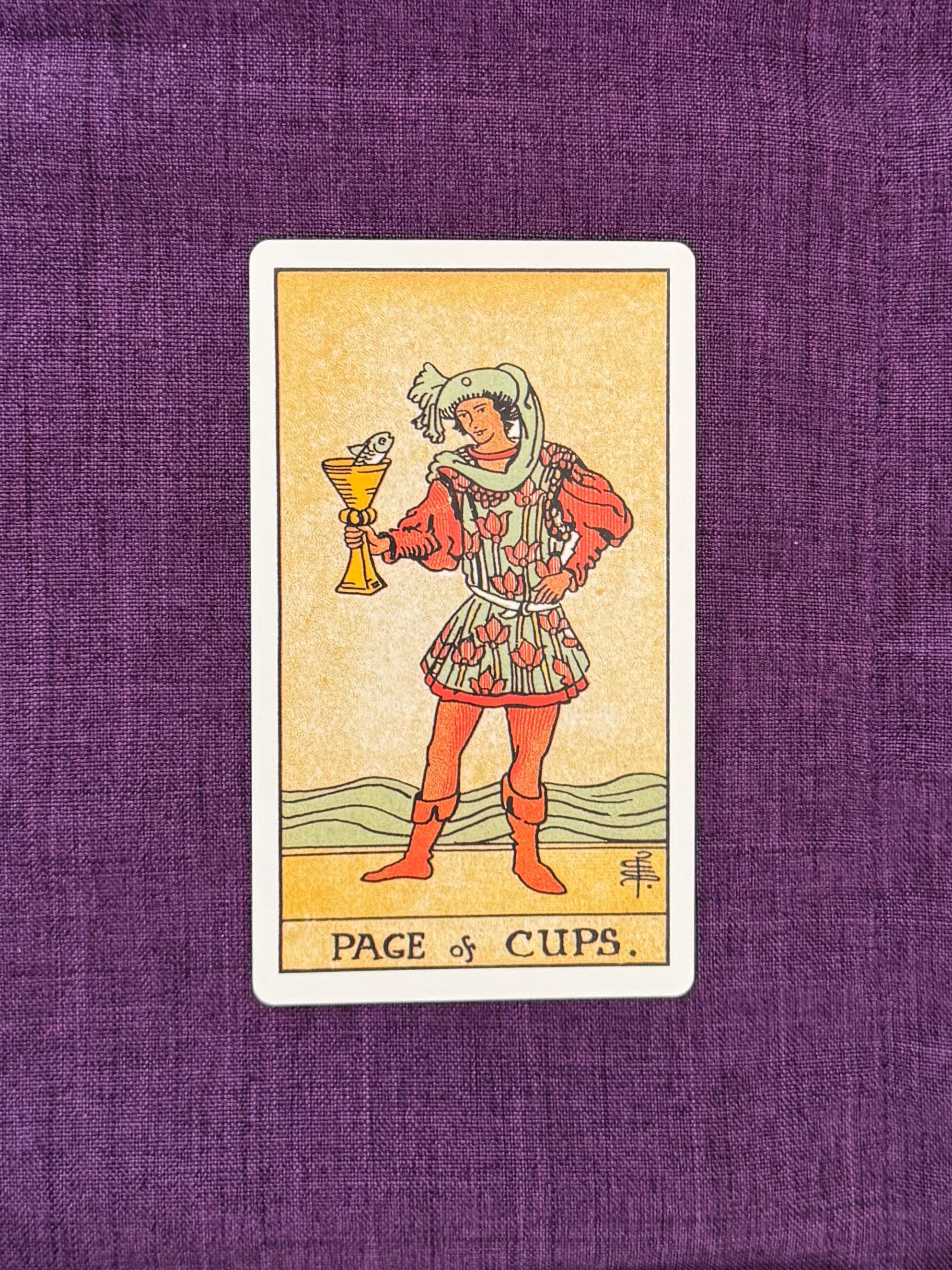
Traditionally, the Page of Cups carries themes of emotional openness, vulnerability, intuition, tenderness, curiosity, surprise, and the willingness to feel something before knowing exactly where it will lead.
The Page of Cups asks:
What do I feel?
What do I want?
What happens if I say it?
What happens if I remain open?
The Page isn’t the Queen of Cups who has mastered her emotional world. The Page is the beginner.
The Page is listening for emotional information rather than immediately explaining it away.
The Page of Cups isn’t armored. That’s precisely why she can be hurt. But it’s also why she can experience intimacy, wonder, romance and joy. She is vulnerable.
The alternative to vulnerability isn’t security. It’s often numbness.
The Page wonders: What might be possible if you try to stop protecting your heart so fiercely and start to listen to it instead?
Thank you for reading this article. Please let me know if this resonated with you. I love to hear from my readers.