


Burying Old Scripts
As a sophomore at St. Rose High School in San Francisco, religion class was taught by the dean of students, Ms. Hack — an ex-nun with a spine of steel and a gaze that could freeze a room. Most of us were terrified of her. She wasn’t cruel; she was simply unbending, the kind of woman teenagers instinctively respect and fear at the same time.

Looking back now, I can see she was decades ahead of her time.
The year was 1975, and she was teaching us meditation and visualization — words few used then. There were no mindfulness books on endcaps, no spiritual podcasts. It was strange, subversive territory, especially within the walls of a Catholic school.
But for reasons I couldn’t have articulated then, I was drawn to it.
She taught us about the “scripts” running in our minds — the automatic storylines we treated as truth. Our job, she said, was to learn to watch them. Identify them. Question whether they helped us or harmed us.
And the truth, once I finally looked, was brutal:
Most of mine were harmful.
Not small-harmful.
Foundational-harmful.
I’m not good enough.
I’m not smart enough.
No one will love me as I am.
I didn’t think of these as beliefs. They were simply the atmosphere I lived in, like weather I didn’t know I could step out of. And because I didn’t know better, I let those scripts run — uninterrupted — for decades.
Awareness
Awareness, I would learn much later, is only the first doorway.
Recognizing the negative self-talk is essential, but it is not liberation.
The second half — the recoding, the rewiring — was the part I never got to learn.
Halfway through the semester, Ms. Hack disappeared from our schedule. New teacher. New curriculum. Meditation gone. Visualization gone. No more talk of scripts or the mind’s quiet machinery.
Without her, we had no guide.
We’d opened the door, but we hadn’t stepped through it.
And so we limped along — each of us in our own private ways — knowing there was another path but having no idea how to access it.
For me, that meant spending most of my life wrestling with thoughts I didn’t choose but somehow believed. Always trying to change. Always slipping back. Always wondering why transformation felt like an uphill climb in wet sand.
People say change is hard.What they don’t mention is how hard it is when no one ever taught you.
Clarity
It took me years — decades, really — to realize that it’s not a process at all.
It’s a practice.
A garden.
One day cleared, the next day overrun.
Weeds pushing through cement with the strength of something ancient, something that refuses to die simply because you’re tired of seeing it.
And then… here I am at sixty-six, back at the doorway I first glimpsed at fifteen.
Only now, I’m finally able to see the real wound.
I used to think the tragedy was how long it took me to change.
But that wasn’t the tragedy.
The real heartbreak was this:
The girl I was at fifteen carried an ache she couldn’t name.
She thought she was unworthy — not because anyone said it outright, but because no one ever said otherwise. She mistook the silence around her for proof. She assumed the pain was her fault. She believed the scripts because she didn’t know she was allowed to question them.
And that belief shaped everything.
It shaped how she loved.
How she hid.
How she dreamed small.
How she disappeared in rooms where she should have taken up more space.
For decades, I blamed her for that.
But now — with the kind of clarity that only age and tenderness make possible — I can finally say the truth she needed to hear:
She was never unworthy.
She was never broken.
She was more than enough, even then.
The tragedy wasn’t her unworthiness —
it was that she lived so long without knowing her worth.
So I became the one who tells her now.
Day after day, gently but without wavering, I lay down a new truth in her hands, a new practice:
You were enough then.
You’re enough now.
You always were.
Action
And once you know that — truly know it, not as an affirmation but as a bone-deep reality — something shifts.
The ground steadies.
The air clears.
The old scripts lose their power.
I used to walk through life bracing.
Now I walk through life aware.
I used to walk as someone hoping to be chosen.
Now I walk as someone who chooses herself.
And this, I think, is the final quiet miracle of all those years of circling:
I didn’t become worthy —
I finally recognized that I always was.
At fifteen, I couldn’t step through the doorway.
At sixty-six, I step through with both feet planted, head lifted, heart unguarded — not because the world told me I was enough,
but because I finally believed the girl who was never wrong about her own worth.
And then the screen widens, the sound dissolves, the scene recedes.
A woman walking forward.
Not searching.
Not striving.Just living in the full knowing of her own enoughness.
Her own worth.
Fade to black.
How do you see old scripts running your life? What needs to change for you to walk through the threshold to something new?
Tarot Pull
Death
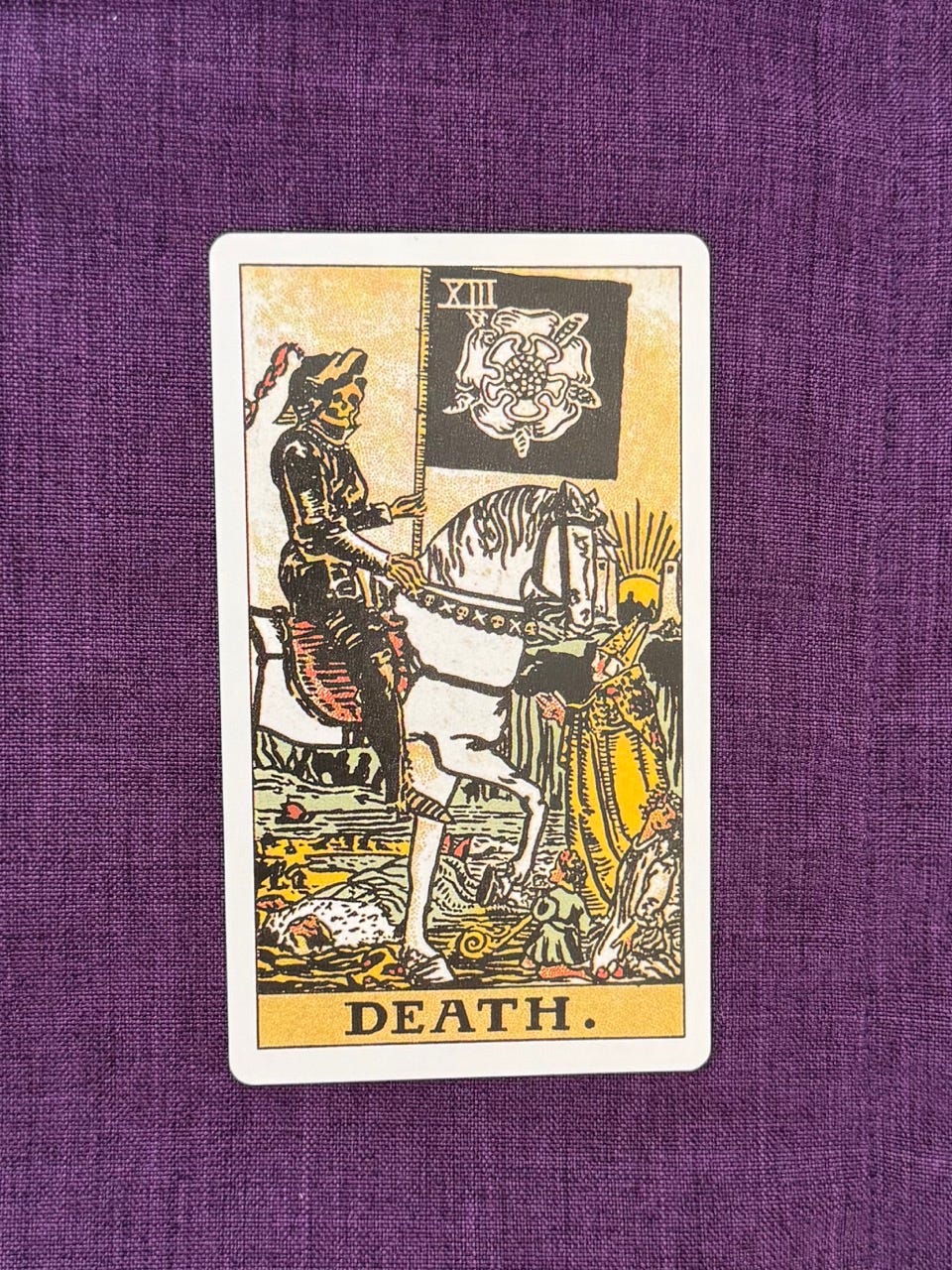
Unbelievable that I would pull the Death card to go with this blog post. The Death card is about crossing the threshold... leaving what has been for what is next... a transition. Just as I wrote about in this post. Death releases the old version of myself that was built on a lie. Here the old script the dies. What is released (the phoenix rising from the ashes) is the me who existed before the wound, before the silence. Death is the return to the truth, shedding inherited shame. It’s liberation. It’s not about becoming something new, but about reclaiming who I always was. Something truer can live. The old story has died and now I am free to live my real story. BAM!!!

How nice to see you pop in here! Thank you so much for reading my blog and for your very kind comment! Happy Thanksgiving to you and your fam! Hugs, Alicia
Best blog yet. You get it!