


I just blurted it out… not in conversation… just a random remark…
“Gunnar (my ex) is a great guy…”
My partner looked at me, surprised. “That’s the first time you’ve said that. What’s great about him?”
I sat there thinking about this. “Well,” I said, “he’s great at making money.”
“Yes, and…”
“He’s a great cook…”
That was all I could come up with. My partner tried to help:
“Did he make you feel great? Did you feel loved when you were with him? Did he listen to you? Did he support you beyond the financials? Did he recognize your needs?”
I sat there.
Then I realized the truth.
I had spent YEARS convincing myself that my husband was a great guy because I needed to believe that myself.

That thought suddenly rose to the level of my conscious mind.
I knew everyone else and their needs but had no idea who I was anymore and what it was I wanted. I had compromised myself so often that I completely lost myself.
I had to believe that, or I would have wasted 30 years…
The Real Cost of the Relationship
What I had been ignoring for all those years was the price I paid for the relationship; the small ways, over time, that I was eroded… How I lost MYSELF…
It started out so small I didn’t notice… the compromises that didn’t seem that important at the time; the attempts to keep everyone happy at the cost of suppressing my own desires, the need to put a good face forward and never realize what was going on in the background. The marriage. The kids. My mother. Always trying to appease.
I knew everyone else and their needs but had no idea who I was anymore and what it was I wanted. I had compromised myself so often that I completely lost myself.
When someone asked me what I wanted… my brain was empty. A void. I learned to deflect. “What are you having?” or “What would YOU like to do?”
There was none of ME left inside my body.
THAT’S self-abandonment.
A survival strategy.
Now I recognize it. When it tries to take over my body, I feel it. I try to resist, but the force is strong… I focus on bringing myself, Alicia Berberich, back. It’s taken a year and a half to recognize the problem and build that awareness.
Now the work starts. To tune in to my desires, reconnect with my body, ignite my curiosity, harness the power of my agency, build my future the way I want it, learn to trust myself and my decisions, and learn to love myself.
Resentment as the Alarm
For years, I thought resentment was proof that something was wrong with me.
Now I see it differently.
Resentment is often the sound of an abandoned self pounding on the door.
It is the part of us that knows we have said yes when we meant no.
The part that remembers dreams we dismissed, needs we minimized, and desires we buried.
At 67, I am finally opening that door.
And every time I listen, I find a little more of myself waiting on the other side.
The Fire Alarm
Self-abandonment doesn’t disappear quietly. It accumulates. And eventually it surfaces — often as resentment toward the people around us.
It was 10 am. I was working at my desk. Suddenly, the fire alarm went off. After I peeled myself off the ceiling, I went to investigate. No fire. Just my daughter in the shower after her run…
Turns out the steam particles in the air set off the fire alarm.
The fire alarm is there to notify us of an urgent need. It doesn’t have the power to analyze the situation to determine whether the change is okay. It just announces the situation.
Resentment is like our internal fire alarm. When we feel overwhelmed inside, we project resentment outward. For example, my daughter tells me I am interfering with her business by pushing my ideas on her. I get upset and take it personally. But the real problem is that I am unable to set my own boundaries, while she has no problem setting boundaries. I admire that she can establish boundaries, and I am mad at myself. I let everyone interrupt me at will. Then I explode for no apparent reason, which is the result of not setting boundaries.
The resentment I feel is like the fire alarm going off, signaling that something is off.
I learned people-pleasing behavior: be flexible, easy-going, and helpful. Then something small happens, and I become irrationally upset. Someone crossed my boundary… But the problem is, I never communicated that boundary, so people are unaware.
Or I have an expectation I hold and don’t communicate, and then feel disappointed or resentful that I am disappointed.
The problem is, I know what I want, but I’m not communicating it and hoping that others will just get it. Then I am disappointed when they don’t, and I feel resentful. “If they loved me, they would know.”
For years, I wanted a particular handbag. (I am a bit obsessed with handbags…) I told my now ex I wanted it for Christmas and my birthday. He knew. But he never got it for me. He got me equally expensive gifts, but never what I wanted. For me, that was painful. Like my desires didn’t matter. When I voiced my desire, it was ignored. So I stopped voicing it. I told myself it didn’t matter.
For years, I suffered from that disappointment. I could have always purchased the handbag for myself. But that’s not what I wanted. I wanted to receive it as a gift.
Instead, I learned not to have expectations to avoid getting upset. I pretended it didn’t matter.
I further abandoned myself.
The Resentment Test
Here’s what I started doing — and I want you to try it too. Complete this sentence:
I resent….
Write down 10 answers.
Then ask:
What need of mine is hidden underneath each resentment?
From my handbag example above, the need I had that was unmet was the need to be heard and valued.
Then ask:
What part of this situation have I been tolerating that no longer feels aligned?
See what you come up with.
Learning
The next time resentment appears, don’t rush to get rid of it.
Listen.
It may be the part of you that has been ignored for years finally finding its voice.
Not to shame you.
Not to punish you.
But to guide you back to yourself.
Resentment isn’t a character flaw. It’s an invitation.
A smoke signal from a part of you that’s ready to come home.
I am Alicia Berberich, and I am navigating the waters of divorce and reclaiming myself after years of self-abandonment. Join me on this journey by subscribing to my newsletter. Also, I guide women going through a gray divorce and can support you on your journey. Contact me if you would like a deeper conversation.
The Tarot Nook
Ace of Pentacles Reversed
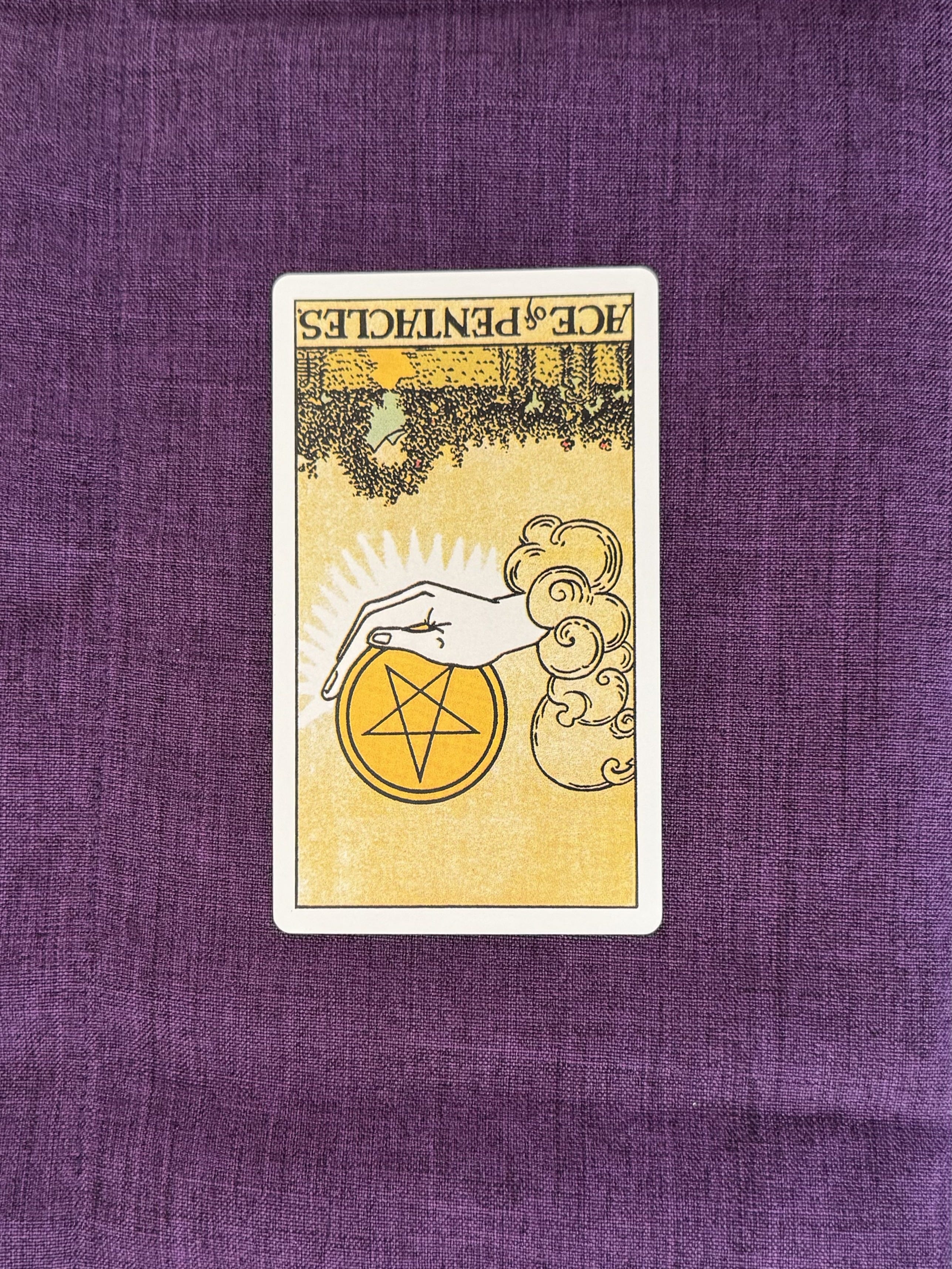
Traditionally, the Ace of Pentacles represents a seed of opportunity, value, and potential. Reversed, it asks us to look at what isn’t being nurtured.
As I reflected on self-abandonment, I realized that my desires never disappeared. They simply stopped receiving attention.
Each time I silenced a preference, ignored a need, or convinced myself that what I wanted didn’t matter, I left another seed unwatered.
Resentment may be what happens when those forgotten seeds refuse to stay buried.
The Ace of Pentacles Reversed asks me: What am I finally willing to invest in?
At 67, my answer is simple.
Me.
This is such a clear naming of resentment as signal.
The part I keep thinking about is that resentment often reveals where a woman has already crossed herself internally — where she said yes, stayed quiet, minimized the need, softened the boundary, or convinced herself something did not matter.
But in my work with women, the question is not only, “What need is hidden under the resentment?”
It is also: what nervous system prediction made abandoning that need feel necessary in the first place?
Because a woman may recognize the resentment. She may know what she wants. She may even understand the boundary. But if her body still predicts danger, rejection, punishment, conflict, or loss of belonging when she names it directly, the pattern can keep repeating.
That is where resolution changes what becomes available. Not just noticing the alarm, but resolving the imprint that made the self-abandonment feel safer than the truth.
Resentment can point to the abandoned self. But resolution helps the body stop abandoning her.