


“Own it, girl,” he said. “Walk with your head up. Stop looking at your shoes… walk like you own the place.”
He was twenty years younger than me. And somehow, he saw something I didn’t.
I wasn’t looking at my shoes because I liked them.
I was looking down because I didn’t feel like I belonged.
I felt new. Exposed. Slightly fraudulent. Like everyone else knew more than I did.
But that day, I tried something. I lifted my chin. Rolled my shoulders back. I walked as if I knew exactly what I was doing.
Nothing catastrophic happened.
No one laughed.
No one called me out.
And something subtle shifted.
I realized confidence isn’t always a feeling.
Sometimes it’s rehearsal.
Decades later, I still hear that voice when I catch myself shrinking.
Walk like the woman who already knows.

The Real Reason Reinvention Feels So Hard
When women enter midlife — after decades of marriage, caregiving, partnership, or stability — they often think their struggle is about confidence.
It isn’t.
It’s about prediction.
The brain is not passively waiting for life to unfold.
It is constantly predicting what will happen next.
In neuroscience and psychology, this is called predictive processing.
Your brain asks:
What kind of person am I in this situation?
What usually happens to someone like me?
What should I prepare for?
And then your nervous system responds as if that prediction is already forming.
Tight chest?
That’s a prediction of rejection.
Urgency?
A prediction of loss.
Withdrawal?
A prediction of failure.
Most people think they are reacting to circumstances.
But they are reacting to predictions based on current identity.
The Cultural Pattern No One Is Naming
Here is what I see repeatedly in women over 50:
They are not lacking ambition.
They are not lacking intelligence.
They are not lacking capability.
The problem is they are running outdated predictive models.
Models built for:
Keeping the peace
Maintaining stability
Preserving belonging
Avoiding relational risk
For decades, those models worked.
They kept marriages intact.
Families steady.
Communities harmonious.
But midlife reinvention requires something different.
It requires updating the internal model.
And your brain does not update through inspiration.
It updates through evidence.
Your Future-Self Is a Neurological Process
Prospection is the brain’s ability to imagine and emotionally simulate possible futures.
But here’s the key:
The future you imagine is not neutral.
It is filtered through past emotional memory, identity beliefs, and repetition.
Which means:
If your identity says, “When I shine, I get judged,”
your brain will predict judgment before you ever speak.
If your identity says, “When I lead, I risk rejection,”
your nervous system will contract before you ever try.
Your future self is not created by willpower.
She is created by updating your brain’s internal model of who you are.
That is agency.
That is emotional regulation.
That is identity recalibration.
The Predictive Identity Loop
Here’s the pattern:
Identity belief forms (“I don’t belong here.”)
Brain predicts threat.
Nervous system contracts.
Behavior shrinks.
Experience confirms identity.
Loop reinforced.
Reinvention requires interrupting that loop.
Not with affirmations.
With embodied evidence.
How To Update Your Predictive Model
If the brain predicts based on past experience, emotional memory, identity, and repetition — then we change the inputs.
Here is the process.
1. Catch the Prediction
Ask: What is my nervous system preparing for right now?
Look for the anticipated outcome, not just the sentence in your head.
Chest tight?
Preparing for rejection.
Pulling back?
Preparing for failure.
This builds metacognition — awareness of the prediction.
2. Label the Old Model
Examples:
When I trust, I get hurt.
When I shine, I get judged.
I have to work hard to earn love.
I can’t make mistakes here.
This is the algorithm running your system.
You cannot update what you are unaware of.
3. Create Multiple Futures
Instead of:
“They’ll think I don’t know what I’m talking about.”
Try:
I am new and learning.
There are multiple paths to success.
I am capable of creative problem-solving.
This can go well.
The brain relaxes when it sees options.
Threat narrows. Possibility expands.
4. Embody the Updated Model
Ask:
If this worked out, how would my body feel?
Then:
Slow your breathing.
Drop your shoulders.
Lift your chin.
Let your posture signal safety.
Neuroplasticity is state-dependent.
Calm states wire differently than stressed ones.
5. Create Evidence
If your old identity says, “I have to do this alone,”
ask for a small favor.
If it says, “I shouldn’t take up space,”
speak first in the meeting.
If it says, “Emotionally available men aren’t attracted to me,”
be the woman who leaves at the first sign of inconsistency.
Evidence rewires.
Repetition stabilizes.
Prediction shifts.
My Identity Recalibration
My prior identity: Married mom with three kids.
But beneath that was something more subtle:
Don’t rock the boat.
Support, don’t lead.
Be good, not bold.
Keep the peace.
Don’t outshine.
That identity kept me safe.
Until it didn’t.
Now my evolving identity is: Woman creating change in the world.
When my chest tightens and I think, “Who am I to do this?”
I recognize it as a prediction.
Old model:
When I shine, I get judged.
When I lead, I risk rejection.
Interrupt.
New model:
I am someone who shows up and does hard things.
I am someone who leads by example.
I am someone who creates change one person at a time.
Then I act.
Over time, my brain gathers new evidence.
Slowly, the prediction shifts.
Now the prediction is:
Of course you’re in the arena.
This is who you are.
Reinvention Is a Nervous System Upgrade
Midlife transformation is not about motivation.
It is about recalibrating the predictive identity loop.
The next time you feel yourself shrinking, don’t argue with the thought.
Ask:
What is my brain predicting?
And then ask:
Who am I becoming here?
Lift your chin.
Update the model.
Rehearse her.
Your future self is not waiting somewhere ahead of you.
She is waiting for your nervous system to believe she is real.

Tarot Pull
Nine of Swords
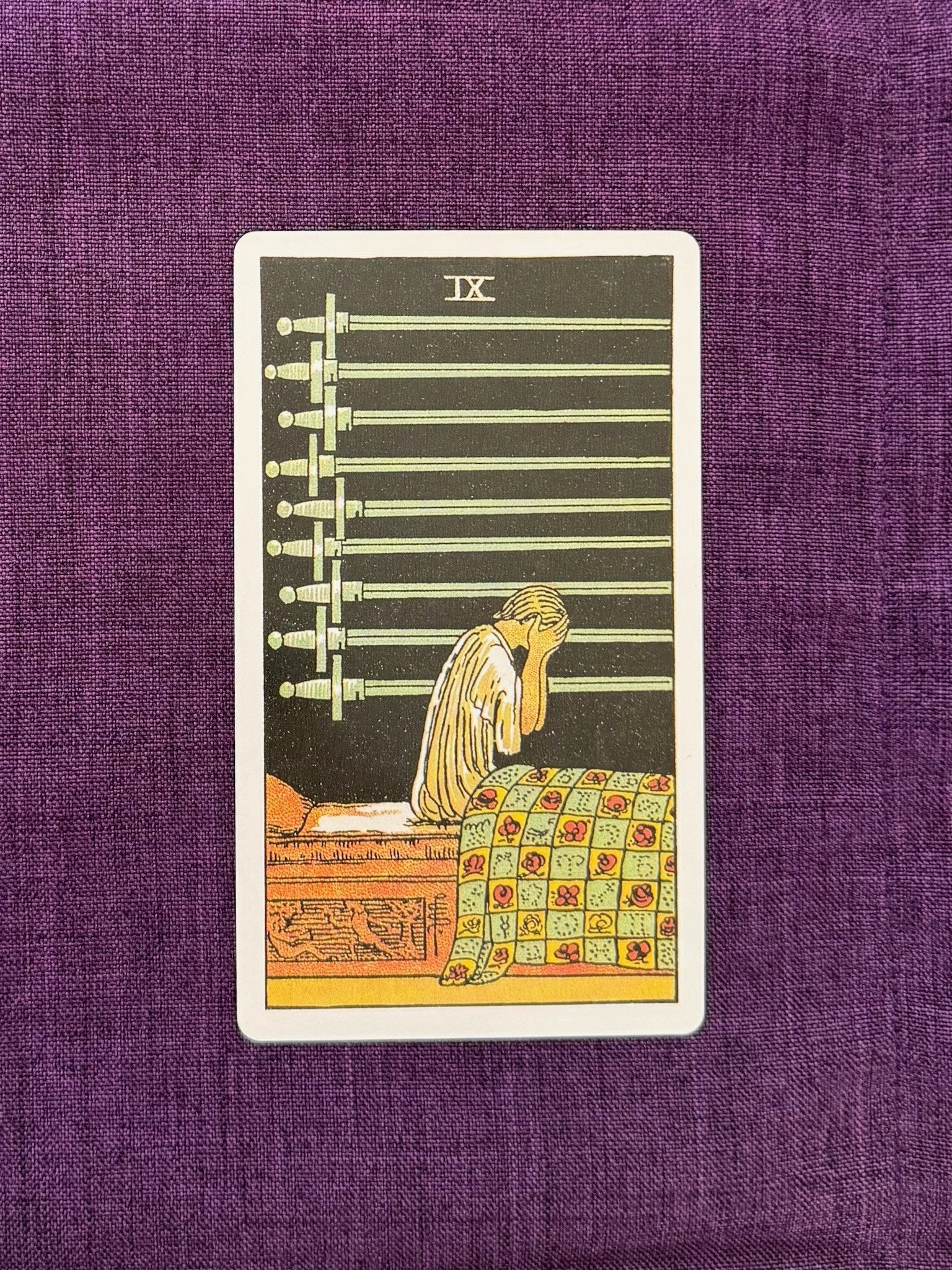
The Nine of Swords is about shame.
And shame is identity-level threat.
For midlife women, the shame often sounds like:
“I should have this figured out.”
“I’m too old to start.”
“Who do I think I am?”
That is not the truth.
That is predictive identity protecting belonging.
The card is not saying, “You’re doomed.”
It’s saying:
You’re believing the wrong forecast. You are not lacking in confidence, You are running outdated wiring. The Nine of Swords is the visual that goes along with predictive processing. Amazing.